
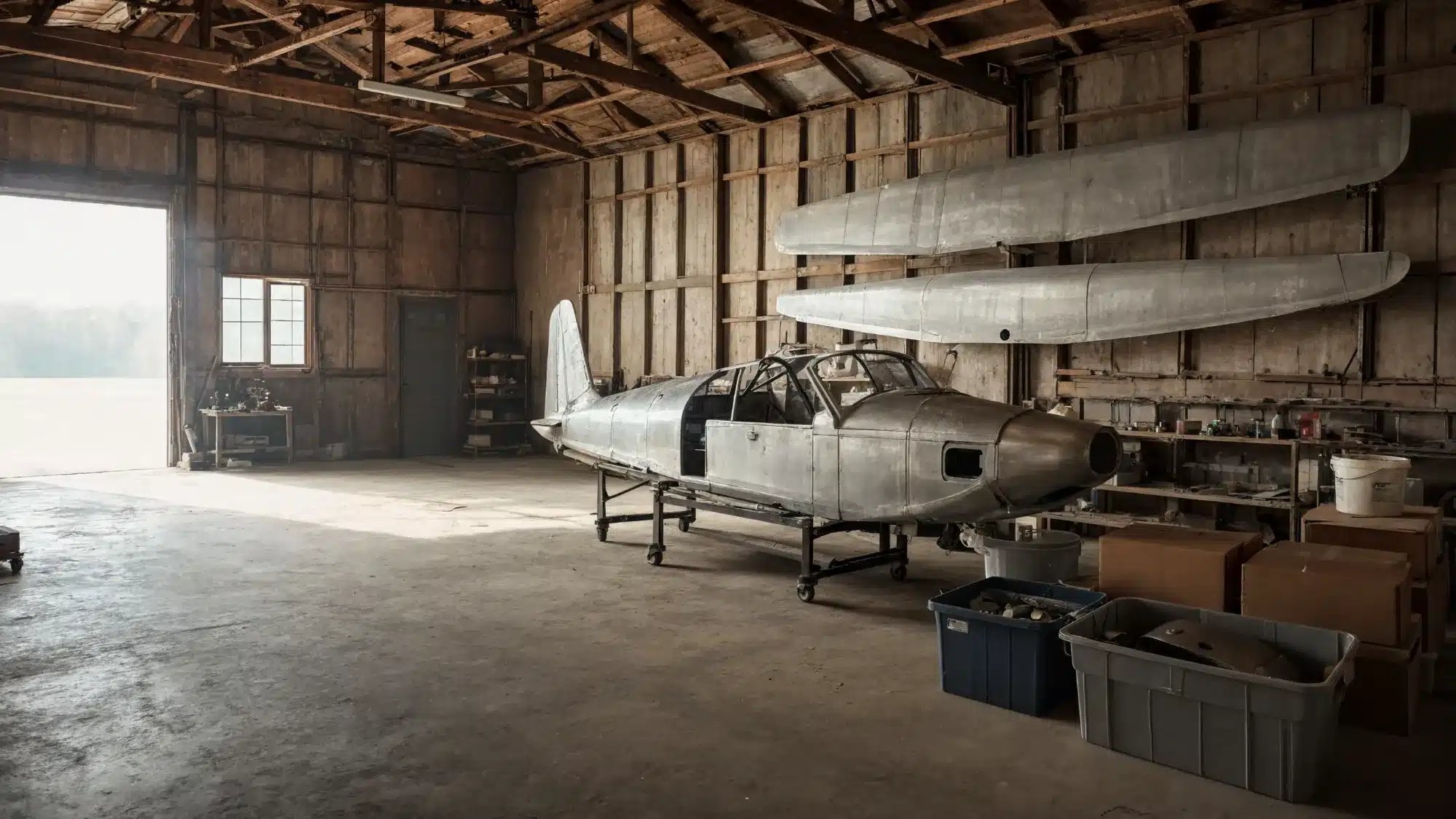
Projects stop for ordinary reasons: a medical, a move, a business, a death in the family. What remains is an airframe in pieces, a pile of kit boxes, and an owner who has quietly concluded it is not going to be finished. Those projects are worth more to a builders’ association, a technical school or a specialist restorer than they are on a classified listing, where the buyer pool is small and every inquiry starts by asking what is missing. This page covers what determines a project’s value, how it travels, and how the paperwork differs from a flying aircraft.
What counts as a project
Almost anything short of an airworthy aircraft, and we take all of it. The distinction that matters for the plan is between a kit-built project and a certified aircraft under restoration, because the paperwork and the recipient differ.
A never-started kit is often the easiest donation on this page. The contents are known, the factory documentation exists, and a builders’ group or school can put it straight to work.
The builder’s log is most of the value
For an amateur-built project, documentation is worth more than any single assembly in the shop. A project with a photographic builder’s log, dated entries and receipts can be certificated by whoever finishes it. A project without one asks the next builder to prove work they did not do.
- Builder’s log and photographs. Dated, ideally showing the interior of structures that are now closed up. This is the single most valuable document in the shop.
- Kit invoices and parts receipts. They establish what was bought, from whom, and when — and for the amateur-built rule they help evidence who did the work.
- Plans, drawings and revisions. Current revision status matters; superseded plans mislead the next builder.
- Engine and avionics provenance. Where the powerplant came from, what was done to it, and whether the panel is certified or experimental equipment.
For a certified aircraft under restoration, the equivalent documents are the airframe, engine and propeller logs, the Form 337 filings for major repairs, and any record of the work done since disassembly. If the logs are missing, see donating an aircraft without logbooks.
Completeness, and what is actually in the boxes
The question every recipient asks is not how far the build got — it is what is still missing. A fuselage that is 70 percent complete with the firewall-forward package and the finishing kit in boxes is a genuine asset. The same fuselage with parts sourced from three sellers and no inventory is a harder placement, though still one we take.
Keep sets together. A wing kit with its hardware bags, a panel with its connectors, an engine with its accessories. Sets that stay together are worth substantially more than the same parts scattered across a shop.
Do not pre-sort or discard. Owners sometimes throw out what looks like junk and it turns out to be the hardware bags. Leave it as it sits. We will inventory on site, and we would rather sort a mess than receive a tidy but incomplete donation.
If some of the kit was sold off years ago, say so plainly. It changes the plan, not the answer.
Moving a project
Nothing here flies out, so every project moves by road, and the work is ours. We bring cradles for the fuselage, racks or crates for the wings and tail, packing material for the boxes, and a trailer sized to the job. For a project in a residential garage or a storage unit, access planning matters more than the drive — a door width and a turning circle decide the equipment we send.
We do not ask you to disassemble anything further, load anything, or provide a forklift. If the project is spread across two locations, which is common, we collect from both.
Where projects go
- Builders’ associations and EAA chapters. Chapter build projects put a stalled airframe in front of a dozen people who want to learn on it.
- Technical and A&P schools. An unfinished airframe teaches sheet metal, composite layup, riveting and wiring better than any mock-up, and schools rarely have enough of them.
- Specialist restorers. For rare types, a restorer with the jigs and the parts network can finish what an individual could not.
- Parts recovery. Where the airframe is past saving, the panel, engine, gear and hardware keep other projects moving.
Which destination applies changes your deduction basis, so it is worth knowing before the paperwork is signed — see the note below.
Paperwork for an unfinished aircraft
This is where projects differ most from flying aircraft. An unfinished amateur-built project usually has no airworthiness certificate and may never have been registered at all, which means there may be no N-number to transfer and no registry record to search.
- A bill of sale for the project as personal property, signed by the owner. For a registered aircraft, AC Form 8050-2 instead.
- The kit manufacturer’s documentation and any serial or kit number assigned to the airframe.
- The builder’s log, plans, invoices and photographs.
- For a registered but disassembled certified aircraft: the registration, airworthiness certificate and all logs, plus a title and lien search as normal.
If the project was registered and then left unregistered for years, the registration may have expired. That is not an obstacle to donating — it only removes the option of flying it anywhere, which was never on the table. The registry mechanics are on the FAA paperwork page.


Valuing an unfinished airframe
Projects are almost always sold rather than retained, which puts the donor on gross proceeds — the amount the project actually brought, reported on Form 1098-C. For property this hard to value, an observed sale price is usually the donor’s friend: a partly built airframe has no published market, and a valuation argument would rest on comparables that barely exist.
Where a school or builders’ group retains the project as instructional material, we certify that intervening use and the fair market value basis applies. Expect a qualified appraisal of a project to discount heavily for missing documentation and for the labor still required — which is the correct answer, not a pessimistic one.
Note the aggregation of similar items: an airframe plus boxed components can cross $5,000 as a group and trigger a qualified appraisal and Form 8283 Section B even where no single item does. The appraisal is the donor’s expense and the donor’s choice of appraiser, independent of the charity; we sign Section B as recipient.
Authority: IRS Publication 526 on charitable contributions, Publication 561 on valuation, plus the Form 1098-C and Form 8283 instructions. Nothing here is tax advice — confirm the figures with your own CPA. How the deduction works →
Related reading
Photograph it as it sits
Pictures of the airframe, the racked wings and the stack of boxes tell us more than an inventory, and we will come back with a collection plan.