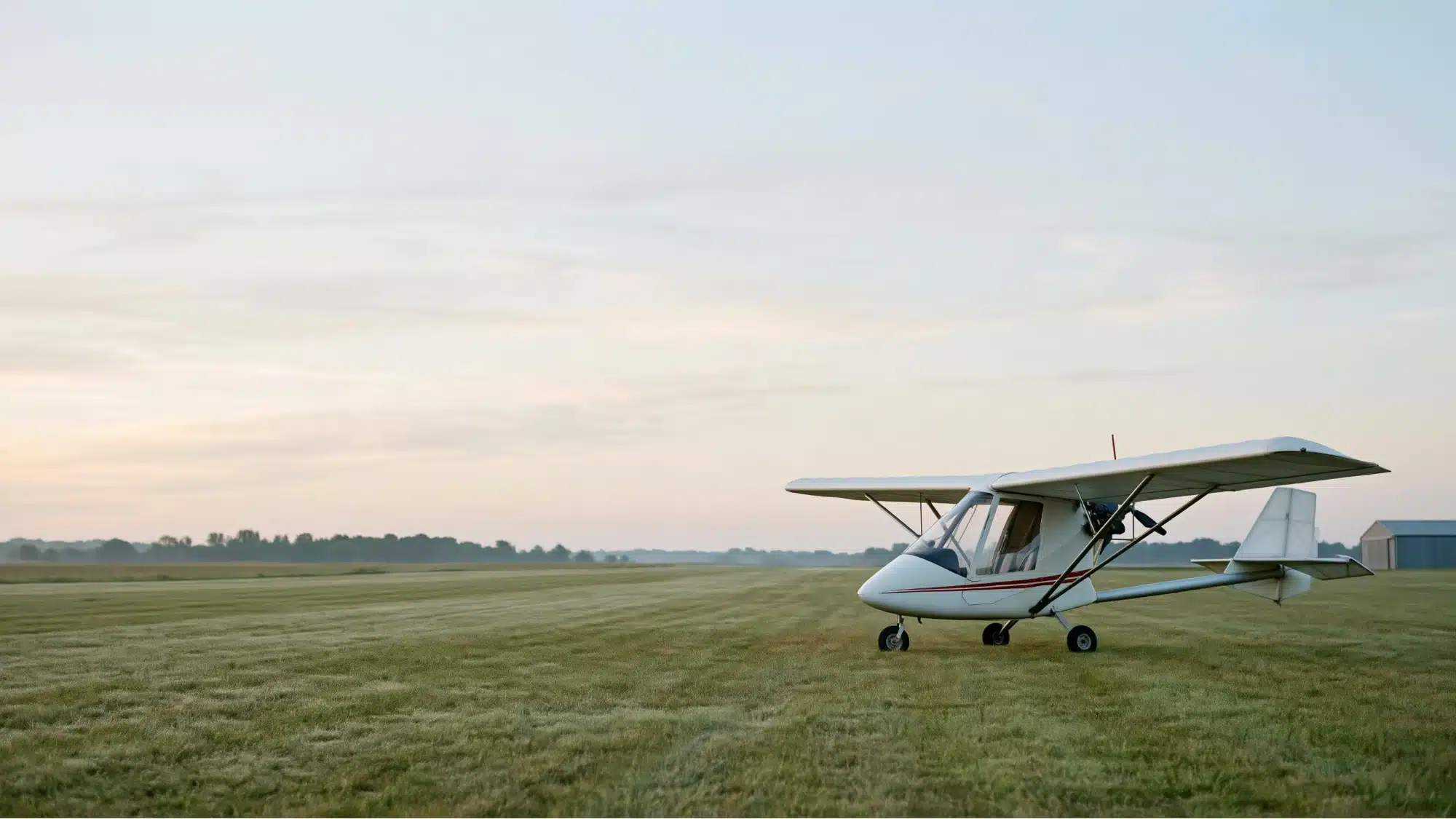
Challengers reach us when a medical lapses, when a private strip gets sold, and when a two-stroke that has not run in five years makes the owner realize the flying is over. The single-seat Challenger I and two-seat Challenger II have been built from Quad City kits for decades, as true Part 103 ultralights in the lightest configuration and far more often as registered experimental amateur-built aircraft. Aluminum tube, fabric covering, an enclosed pod cabin on a single boom and a Rotax two-stroke pushing from behind the wing. Values are modest, the paperwork is light, and schools, youth programs and clubs want every one of them.
What moves the number on a Challenger
Registered or Part 103. A registered experimental amateur-built Challenger transfers through the FAA like any other aircraft. A true Part 103 vehicle has no N-number and no registration, which makes the handover a bill of sale and nothing more. Tell us which you have — and if you are not sure, we can tell from a photograph of the tail.
Engine hours and rubber. Rotax 503 and 582 two-strokes carry short overhaul intervals, and the rubber — fuel lines, carburetor sockets, the drive belt on a belt reduction — ages on the calendar whether or not the engine runs. Tell us the hours, the last rebuild and how long it has sat. An engine that will not start is still an engine.
Fabric and tubing. Dacron covering fades and weakens in the sun, and a wing that has lived outdoors may need recovering. Tube frames should be checked at the clusters and along the boom for corrosion and old repairs. None of this stops a donation; it decides whether the airplane flies again or teaches a class.
Wings, floats and extras. Long wing or clip wing, floats, skis, a ballistic parachute with its repack date, a second set of covers in the rafters. All of it is part of the donation and all of it has value to the next owner. Tell us what is there.
How a Challenger gets to us
Almost always a trailer. The wings come off at the root fittings in an hour or two, the tail folds or detaches, and the whole aircraft rides on a flatbed or an enclosed trailer; many owners already have the trailer, and we bring the padding either way. Where it is airworthy and the distance is short, a ferry flight is possible, but trucking is faster and simpler for everyone. Every route is at our cost.
What the first call covers


What you can deduct for this aircraft
Most Challengers are worth less than $5,000, which keeps the paperwork simple: Form 8283 Section A, no appraisal, and your deduction is the gross proceeds when the aircraft is sold, reported to you in writing after the sale. Where a Challenger goes to a youth program or a school that keeps it and flies or teaches with it, a fair market value basis can apply instead. If yours is a late Challenger II with a fresh engine and floats that would clear $5,000, you will need a qualified appraisal and Section B, at your own expense and your own choice of appraiser, because the IRS requires it be independent of us.
We sign Section B as the recipient charity, and the IRS requires your appraiser be independent of us.
Rules for aircraft gifts are in IRS Publication 526, valuation in Publication 561. Nothing here is tax advice — confirm your figures with your CPA. How the deduction works · FAA paperwork
Other models in this class
Start with the N-number
We will pull the registry record before we call you back.